

Whether it’s fresh produce in the refrigerator or white rice and canned beans in the pantry, everything has a shelf life. And the clock starts ticking at food and beverage plants, where the pressure to move goods around the facility and out the door is immense.
Forklifts play a vital role in operational efficiency by transferring raw ingredients and packaged goods quickly through receiving, storage, production, packaging, and shipping areas. But when these powered industrial vehicles collide with rack systems, structural columns, or pedestrians, the financial and human toll can be severe.
Beyond immediate damage, forklift-related incidents halt or impede production, adversely affect workers, raise liability issues and compliance questions, and damage reputations. This makes forklift impact protection systems not just a safety choice, but a sound business investment.
Item pricing the impact of accidents.
Forklift accidents in a warehouse can generate costs that far exceed repair bills. For food and beverage facilities, the repercussions can extend into these often-overlooked consequences:

Product Loss & Contamination Risk
A strike on a pallet rack can spill expensive ingredients or finished products onto the floor. In a food environment, this creates immediate sanitation issues by attracting pests and requiring extensive cleanup to prevent contamination.
Costly Operational Downtime
While a damaged rack is assessed and repaired, the aisle and adjacent areas are usually cordoned off. This shrinks functional storage space, which can disrupt fulfillment and create backlogs.
Higher Insurance Premiums
How many claims for vehicle, structural, and inventory damage before insurance premiums rise? Insurers view repeated impacts as a sign of poor risk management.
Regulatory Scrutiny & OSHA Violations
Beyond the immediate risks, failing to meet OSHA forklift safety requirements—which mandate hazard prevention and proper separation of vehicle and pedestrian traffic—can trigger investigations and sizable fines.
Stack up the safety and control measures.
Operator training and proper signage are a good start; however, mitigating these risks requires barriers engineered to absorb impacts and channel traffic safely. Industrial safety barriers featuring high-visibility yellow finishes reduce collision frequency and severity by clearly delineating vehicle zones from pedestrian areas and critical infrastructure.
Here is a checklist of how to deploy forklift safety barriers for comprehensive food and beverage warehouse safety:
1. Protect Storage Racks with Dedicated Guards
Racking is the lifeblood of warehouse storage, but racks are vulnerable to impact during loading. Damaged racks jeopardize inventory integrity and can lead to collapsed loads.
Rack Guard Systems with Rack End Guards, and Rack Upright Protectors provide excellent pallet rack protection. They shield the most exposed part of your racking from forklift impacts without interfering with access to the inventory.


2. Define Safe Traffic Corridors with Guardrails
Separating forklift traffic from pedestrian walkways, machinery, building infrastructure, and other sensitive areas is crucial for all-around safety.
Floor-mounted Safety Barriers create clear, protected pathways with robust, steel guardrail systems designed to absorb significant impacts. Their modular design allows easy reconfiguration as your facility changes.
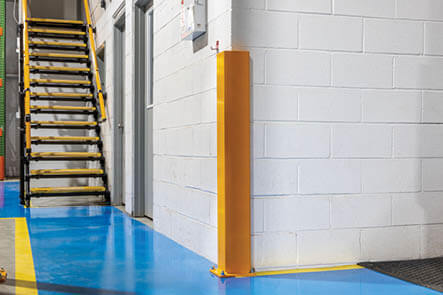
3. Shield Corners with Special Guards
Corners should never be cut, but they can protrude unnoticed in the array of a food and beverage processing plant layout. A serious hit can compromise structural integrity.
Corner Guards installed at the base of a wall or office corner provide maximum protection against front and side impact and are easy to replace if damaged.
4. Keep Traffic at Bay with Floor Angles
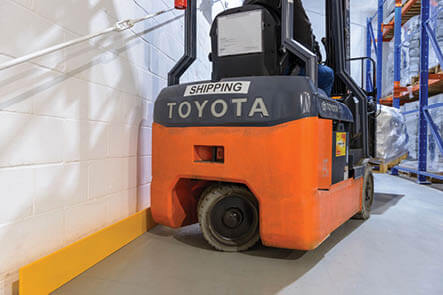
The bases of racks, walls, and machinery are all susceptible to incidental impact that can cause considerable damage.
Floor Angle Guards feature heavy-duty, thick steel angles that can be cut-to-size for installation where needed.
5. Safeguard Entry Points with Bollards
Loading docks are high-traffic zones where impacts that can damage door jambs and walls are common.
Bollard Post Shields at dock doors and building perimeters are designed to absorb the impact of a forklift or other in-plant vehicles, and HDPE Pipe Bollard Covers slide over existing pipe guards to help maintain appearance and resist corrosion.

Take the initiative for a safer, smarter facility.
Food and beverage facility managers can choose proactive protection by investing in comprehensive industrial barrier systems. They safeguard product integrity, protect your workforce, and ensure your operation remains productive and profitable.
Keep forklifts where they belong—efficiently moving materials without compromising worker, inventory, and structural well-being. Contact Omega Industrial Safety today to enhance safety and productivity at your food and beverage plant.