

It can be hard for the average person to envision a data center. We think of it as “The Cloud” – nice fluffy stuff in the sky – or for Artificial Intelligence, conjuring the image of a brain, more spongey than fluffy.
In reality, a data center is a modern version of the Terracotta Army in China, with row after row of servers mounted on racks instead of cavalry on horseback. While a legion of IT experts focuses on firewalls and encryption, data center safety hazards related to moving equipment, building infrastructure, and rooftop access often go overlooked.
It took some 2,000 years for the Terracotta Army to be unearthed by accident. From vehicle traffic on the floor to dangerous roof openings and leading edges, accidents will occur frequently unless a proactive approach to protection is implemented—one that addresses people, equipment, and the building.
How to avoid structural column damage.
Large data centers rely on forklifts and pallet jacks to move heavy equipment, and every ride across the floor is a potential collision with a load-bearing column. Impact can compromise structural integrity, damage conduits, or impair electrical and plumbing systems that the column may support. These can trigger unplanned outages and threaten data center infrastructure protection.
Installing column guards for data centers is an effective way to prevent impact damage. These rigid supports are available in 11-inch and 15-inch widths to encase H-beam, round, or square building columns in a highly visible yellow frame that absorbs collision forces before they reach the structure.

How to protect exposed equipment and hardware.
Servers, UPS systems, cooling units, and power distribution equipment represent enormous capital investments, and they are often positioned near high-traffic aisles. Even a glancing blow by a forklift can cause vibrations that degrade sensitive servers over time.
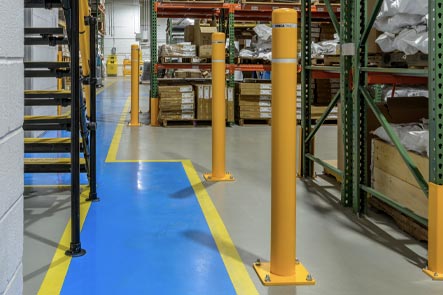
Strategically placed equipment protection bollards create a physical buffer between moving vehicles and these high-cost assets, as well as loading docks and door jambs. They are available in 4-inch and 6-inch diameters in both surface-mount and core-mount configurations. Presenting a clear visual cue for operators, they are easy to retrofit on data center floors with or without raised flooring systems.
How to prevent falls from elevated levels.
Many data centers occupy multi-level facilities, with mezzanines used for cable management, cooling systems, or storage. Without proper barriers, these elevated areas become serious fall hazards for technicians working at height.
Installing industrial safety railing along leading edges and elevated walkways is a regulatory requirement and a necessary safeguard in data centers. They prevent falls from height and segregate areas for pedestrian and vehicular traffic. Integrated self-closing safety gates protect openings on platforms, at stair access points, and in restricted areas.
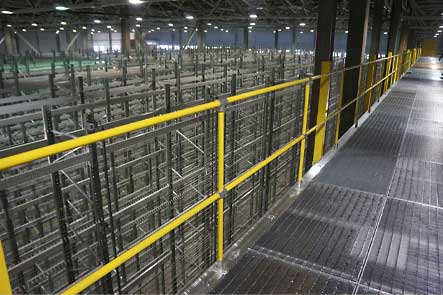
These safety railing systems are constructed of strong, durable, corrosion-resistant aluminum or galvanized steel. They are engineered to meet or exceed OSHA standards for height (42 inches +/-3 inches) and to withstand a force of 200 lbs. outward or downward anywhere along the top rail.
How to protect against falling through skylights.
Roof skylights pose a serious and often overlooked risk. Technicians accessing rooftop HVAC units or solar panels may not realize that skylight panels cannot bear human weight — and a fall through a skylight can be disastrous.

Permanent skylight safety screens offer an effective, always-in-place solution. Constructed of galvanized or stainless steel, they provide an OSHA-compliant mesh covering that does not block the sunshine. Since the screens clamp to skylight curbs, their non-penetrating design does not introduce potential leak paths through the roof membrane.
Take the initiative for a safer, smarter facility.
No single product eliminates every hazard, but a comprehensive approach — combining column guards, bollards, industrial railings, skylight fall protection— creates multiple overlapping layers of protection.
By proactively addressing the risks to building structure, equipment assets, and human lives, facility managers can protect their infrastructure, their uptime, and the people who keep it all running.
Contact Omega Industrial Safety today to enhance safety and help ensure uptime at your data center.