

What would the manufacturing world look like without forklifts?
It would be slower, more expensive, more labor-intensive, and smaller in scale. Armies of workers would need brute strength to push hand trucks, pallet jacks, carts, dollies, and wheelbarrows. They would rely on ramps, pulleys, levers, hoists, and improvised methods to move materials. Welcome to the 19th century.
Forklifts increase the capacity and productivity of any operation; however, forklift accidents can substantially erode these gains, resulting in damage to the vehicle, machinery, equipment, infrastructure, inventory, and, most unfortunately, workers. The trade group American Forklifts cites reports of nearly 100,000 serious and non-serious injuries and an average of 87 fatalities annually due to forklift accidents.
The organization champions three critical areas of remedy, including training and inspections per Occupational Safety & Health Administration (OSHA) standards, and protection—implementing strategic barriers throughout a facility.
Creating clear boundaries for traffic.
Maintaining robust manufacturing floor safety is a challenge, as the dynamic interaction of forklifts, pedestrians, and infrastructure presents constant collision risks. Even the slightest accident halts production and likely causes damage.

The most effective strategy to mitigate these risks is proactive, engineered physical protection. By deploying a comprehensive system of forklift safety barriers and industrial guardrails, facilities create a safer, more organized, and resilient operational environment. This physical separation significantly reduces the risk of a forklift striking a worker.
• Traffic Shield Guardrail establishes non-penetrable boundaries between vehicle aisles and pedestrian walkways or workstations. They feature heavy-duty steel construction and a modular design to adapt easily to most applications. These dedicated safety barriers for forklifts feature a high-visibility, powder-coated finish and form a comprehensive network of warehouse forklift protection barriers. Traffic is effectively channeled into clear operational zones.
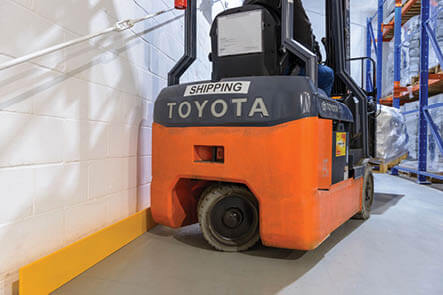
- Floor Angle Shield Guards are floor guide rails that serve a dual purpose. Installed along walls, rack supports, and machinery, they protect the building’s structure from glancing blows and scraping forks. They also act as a tactile guide for operators, helping to keep vehicles centered in aisles and away from hazards, reinforcing disciplined driving, and preventing costly damage.
Protecting critical infrastructure and assets.
In addition to traffic lanes, the manufacturing floor contains vulnerable fixed assets prone to devastating impact damage. Structural columns, electrical panels, machinery, and piping all require dedicated protection, such as column and pipe guards.
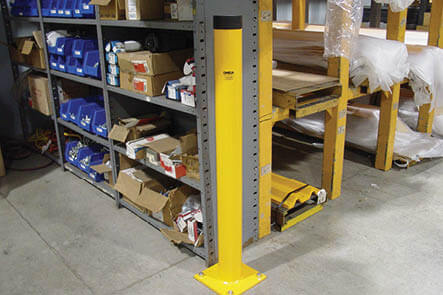


• Bollard Post Shields provide heavy-duty bollard protection by acting as a vertical impact barrier in front of critical equipment and corners
• Column Shields wrap around columns to protect structural integrity and the mechanical, plumbing, and electrical apparatus they support.
• Pipe Shields are a similar protective guard specifically for pipes, absorbing the kinetic energy of impact. They safeguard the structure and prevent fluid leaks and further damage.
Completing the safety network.

Industrial Safety Railings integrated into the safety plan complete the protective ecosystem. While distinct from impact barriers, handrails clearly define safe pedestrian pathways, reinforce the separation created by larger guardrails, and provide stability for workers. They further reduce the chance of a pedestrian inadvertently stepping into a designated forklift travel path.
The tangible benefits of a proactive approach.
Installing guardrails and supplemental barriers improves operational efficiency by clarifying traffic patterns and reducing unscheduled downtime, property damage, and injuries to workers caused by collisions. They also support regulatory compliance and foster an initiative-taking safety culture.
This physical plant protection addresses common causes of forklift accidents—veering off path, loss of control, and human error. Proactive understanding of these risks safeguards a company’s people, equipment, inventory, and reputation.
Contact Omega Industrial Safety today to learn how you can meld forklift safety and manufacturing productivity into your operations.